DRONE SAFETY TEAM (DST)
Safety Management System (SMS) Guidance
Program Overview & Guidance Suite
Welcome to the Drone Safety Team (DST) Safety Management System (SMS) resource. This collection brings together voluntary, consensus-based safety guidance for unmanned aircraft systems (UAS) operators of every size, from recreational flyers to enterprise-scale organizations. The materials here are the product of a multi-year collaborative effort among safety professionals, operators, regulators, and community organizations working together through the Drone Safety Team.
Why Safety Management Now
UAS operations have reached a remarkable scale, now numbering in the tens of millions of flights each year and supported by hundreds of thousands of certificated remote pilots. The industry's rapid growth is marked by strong safety performance, with approximately 4.2 million operations annually recognized by the FAA, characterized by very low incident rates and no fatalities. Sustaining that record as operations continue to grow means catching precursors before they become events. An SMS is one scalable mitigation that grows with operational complexity, helping operators build the organizational safety infrastructure that keeps pace with their work.
About the Drone Safety Team
The DST is a collaborative body that brings the regulator, the Federal Aviation Administration (FAA), and the operator community together to advance UAS safety. The DST develops voluntary, consensus-based safety enhancements through data-driven collaboration and shared experience across the UAS community. The FAA is a partner in this work.
The DST builds consensus in part through working groups. The Safety Management System Working Group was charged with exploring how the principles of safety management systems can be applied to UAS operations in a way that is practical, proportionate, and useful to operators at every level of complexity. The result is the guidance suite presented on this website. This guidance is a DST product and is not an FAA publication.
How the Guidance Is Structured
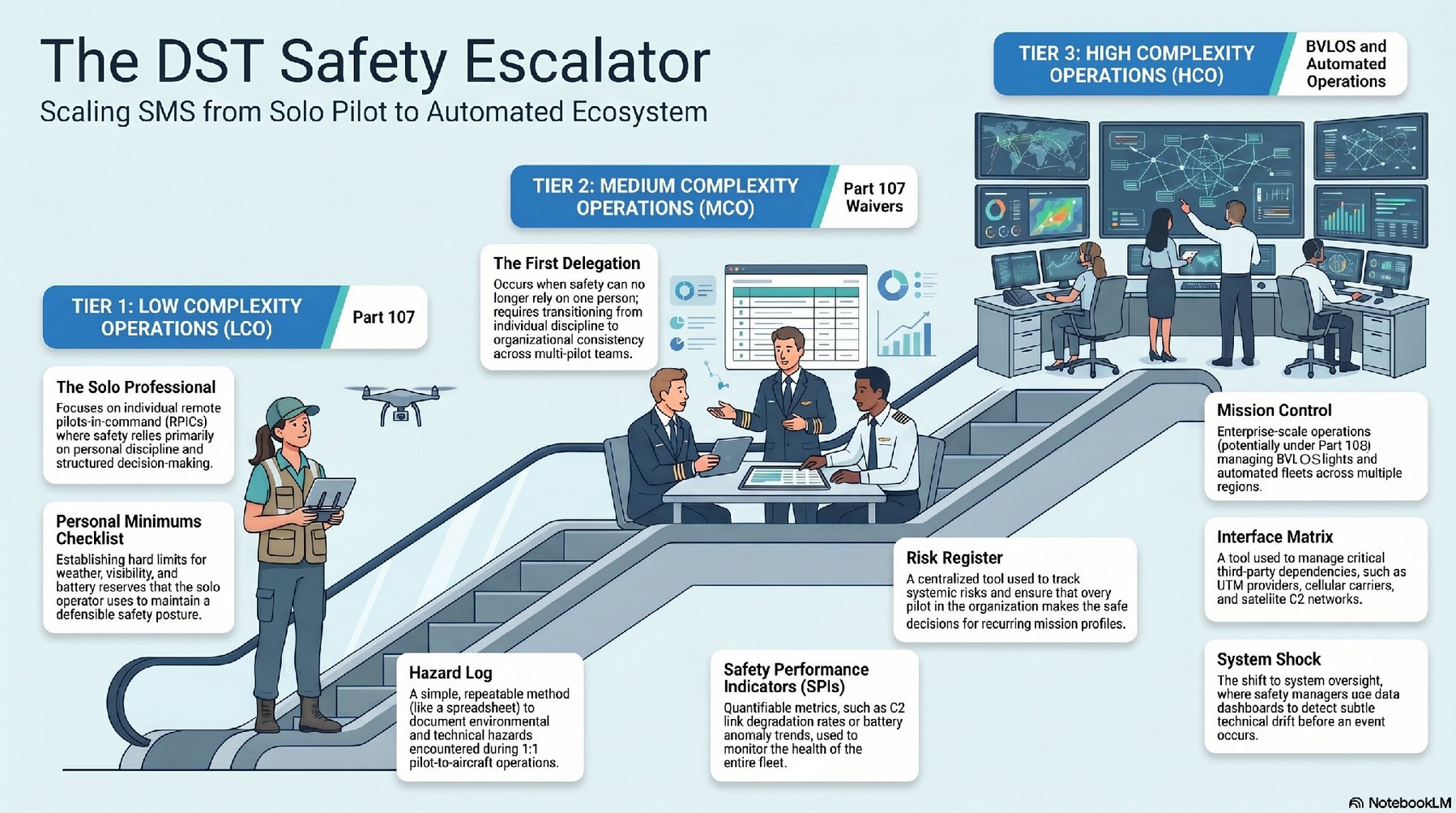
The working group developed a three-tiered approach that aligns practical safety management practices with the evolving complexity of UAS operations. The framework is designed as a safety escalator, with proportionate guidance at each tier so that safety structure grows naturally alongside an operation.
Low-complexity operations (Tier 1) establishes disciplined foundations for individual operators or single-pilot operations, where safety relies primarily on personal discipline and structured decision-making.
Medium-complexity operations (Tier 2) standardizes safety across multi-pilot organizations and recurring operations, where safety management transitions from individual discipline to organizational consistency.
High-complexity operations (Tier 3) manages safety across systems and ecosystems for enterprise-scale operations, where safety relies not only on internal processes but also on external systems with advanced automation.
Separate from the three tiers, the suite also includes a recreational resource contributed by the FPV Freedom Coalition. The coalition is a nonprofit advocacy and safety education organization for recreational pilots who use first-person-view goggles and fly under the guidelines of FAA-recognized community-based organizations. Their contribution introduces sound safety habits to recreational flyers and serves as a welcoming entry point ahead of Tier 1.
All guidance across all three tiers is voluntary and consensus-based. Some operators at higher-complexity levels may be required to implement an SMS under their specific regulatory framework or contractual obligations, but the guidance itself does not impose that requirement.
Choosing the Right Document
Each guidance document is written to stand on its own. An operator can pick up any single manual and understand the complete picture, including where their operation sits within the broader framework, without needing to read the other documents first. Each manual opens with a common overview of the full suite and then focuses on the practices appropriate to that tier.
Recreational flyers should begin with the resource contributed by the FPV Freedom Coalition. Individual remote pilots and single-pilot operations should use the low-complexity operations guidance. Multi-pilot organizations with recurring operations should use the medium-complexity operations guidance. Enterprise-scale operators that manage automated fleets across regions should use the high-complexity operations guidance. Operators are encouraged to adopt the tier that best reflects their current operations and to transition as their operations evolve.
The Safety Management Toolkit
Alongside the guidance manuals, the DST has assembled a Safety Management Toolkit of practical implementation resources contributed by operators and organizations across the community. These resources include real-world risk assessment worksheets, flight safety briefs, risk matrices, corrective action examples, safety performance indicators, and enterprise implementation narratives. They are provided for educational and illustrative purposes only. They are not regulatory requirements, and their inclusion is not an endorsement of any organization or approach.
Each guidance manual closes with a toolkit reference page listing the resources most relevant to that tier so operators can move directly from guidance to practical examples. The complete toolkit, with all resources across every tier, is available here on the DST website. The toolkit is a living library, designed to grow over time as additional contributions are received. The DST SMS Working Group has defined the what and the why of drone SMS; the toolkit is where the community contributes the operational how. Operators are invited to volunteer practical tools, templates, checklists, and real-world samples, all voluntarily, to lower the barrier to effective SMS across the ecosystem.
The DST gratefully acknowledges the organizations and individuals who contributed to the toolkit: the FPV Freedom Coalition; the University of California, Berkeley; the Mid-Atlantic Aviation Partnership at Virginia Tech; Harrison Wolf; UPS Flight Forward; DroneUp; Verizon; and Wing.
How This Website Is Organized
This SMS home page introduces the project and links to each part of the suite. From here you can reach the recreational resource, each of the three-tiered guidance manuals, and the full Safety Management Toolkit. The four core guidance areas and the toolkit are presented with equal prominence so that no single tier appears more important than another. Operators are invited to find their complexity level, download the guidance that fits, and draw on the toolkit for practical implementation examples.
This resource reflects the shared commitment of the UAS community to safe integration into the National Airspace System. We welcome operators at every level and encourage you to begin wherever your operations are today.
Drone Safety Team SMS Guidance Suite
Approved by the Drone Safety Team, July 2026

